Bikes for the World

Tuesday, August 27, 2013

How Can I Help?

What's the connection between Lincoln, Nebraska and Baclayon National High School in Bohol, Philippines? The answer is next month's Featured Volunteer!

Meet Carlton Styron. Back in December of 2012 Carlton sent us an email:

Hello, My Name is Carlton Styron and I reside in Lincoln, Nebraska. As I will be moving soon to the Philippines, I had the notion to find a worthy and helpful cause to participate in while there, and found your website. I am a huge bike lover and mechanic. Do you need help with anything in the Philippines?

 It was that simple question in nothing more than an introductory email to Bikes for the World that got the wheel turning. We put Carlton in touch with Bikes for the Philippines Director Joel Uichico who was at that moment awaiting the arrival of a second container of bikes from Bikes for the World.

Once bikes arrive in Manila, Joel faces the daunting task of not just unloading five hundred plus bikes, but reassembling and fixing almost all of them. Donated bikes are discarded for a reason, most often, they need repaired. Here's where Carlton comes in.

Recently, a dedicated crew of Pinoy volunteers gathered together to turn these bikes from Bikes for the World back into valuable, usable bikes that will help keep kids in school in remote areas of the Philippines. These bikes were donated by individuals in the Northern Virginia area as well as from the national retail chain DICK'S Sporting Goods.

Carlton was one of the many volunteers who assessed and fixed  the bikes that would be donated to the students in Bohol and Cebu. He quickly noticed the need for spare parts, new and used, when trying to give these old bikes a new life. 

"First we go through all the bikes, set the handle bars, install the pedals and do minor repairs. An assessment is taken of each bike to know of any other problems, then the more experienced mechanics take care of the rest. It works smooth as silk," Carlton Styron

This blue bike you see him with here came to us through a special donor from New Jersey who goes by the name Plong-Plong. Plong is originally from the neighboring town where our bikes were first donated. He knows the terrain well that these students navigate just to get to school. He contacted Bikes for the World desperately wanting to help. The handful of bikes he donated are among this shipment being sent to the second school district in Bohol.

Recently Carlton had the opportunity to travel to the island of Bohol and meet the kids he was helping in that warehouse in Manila. Putting a face to a frame really puts this kind of work in perspective.

Leila Ungab is one of the new beneficiaries in the Bikes for the Philippines education program. Carlton is the mechanic who revived her donated bike that will help get her to and from school quickly and safely.

While in Baclayon, Carlton met with the teachers behind the success of this program. He saw first-hand how valuable these bikes are to the student residents who need them to get to school on time. He also got share some of his bike knowledge with the young budding mechanics. All students who receive a bike are required to know certain maintenance techniques to keep the bike in good standing.

Carlton Styron is an individual example of the global reach of this program. Carlton's wife was from the Philippines and he wanted to experience Philippine life. He also loved bikes and wanted to give something back during his stay. He reached out to Bikes for the World to make a difference in his new home in the Philippines before he even left Nebraska. We introduced him to the perfect meld: Bikes for the Philippines.

When Carlton began with this organization what he found  was a well organized program with an amazing leader. "Joel is the perfect person to head this up. He has a big heart for the children," Carlton recently reported to us via email. What he also found, was a rewarding volunteer experience that was making a difference in a community half a world away from his previous home.

You can help support this Bikes for Education initiative by supporting Bikes for the World right here at home. You can donate a bike, your time, or financially to help bring a bike to someone who will use it to make a positive impact on his or her life. Bike accessories and new and used parts are a big part of what keeps this program sustainable. Your donation will help us provide used bikes, training, or tools to mechanics in need. DONATE TODAY.


Monday, August 12, 2013

Bikes for Education

Last month Bikes for the World's partner Bikes for the Philippines signed a Memorandum of Agreement with the Department of Education in the Philippines.

Education Secretary Armin Luistro said bike donations from the Bikes for the Philippines Foundation Inc. will provide suitable means of transportation for poor but deserving individuals and help teach them valuable skills making this a two pronged benefit.

"The students have a hard time going to school due to lack of suitable transportation and they are at high risk of dropping out," Luistro said. “The bikes will not only help them get to school but also provides a way to teach road safety and environmentalism.”

The importance of this project, dubbed Bikes for Education, is clear and simple: keeping kids in school. Throughout the Philippines the drop rate among students is a persistent problem. According to DepEd data, the drop-out rate among high school students in Bohol was high at 5.63 percent in 2011.

This pilot bike project brought about 150 bikes to students in Bohol with another 200 about to be delivered to a neighboring school district. Recently another 50 were delivered to a school on the island of Cebu. Every single bike represents one step closer to graduation for its new owner.

Many students are responsible for chores around the house before and after school. Beneficiaries in the bike program all live 3km or more from school and many of them walk this distance to and from school every day.

The school day runs from 8 to 5 and if the kids are late they have to sit out until the afternoon session, missing valuable lessons. The roads to school are also steep and rough and students are often walking home in the dark. After completing family chores there is little time for homework.

On the rough, sometimes crowded roads in these remote towns you might find an overcrowded bus with students hanging off the roof. Jeepneys and habel-habels (seen left) can be found on the shared roads these kids are traveling to and from school.

Although motorized transportation is available in these areas, the fares are often too expensive. The rides can also be quite dangerous. Walking six miles round trip to school is often a burden some families cannot endure and students are forced to drop out.


Beneficiaries in the program are required to wear helmets and pass extensive written and hands on tests regarding road and bike safety and maintenance.

Students are encouraged to mentor younger students and often take part in community activities from feeding orphans, to spreading cycling advocacy in town, to standing up for environmental causes like Earth Hour.

Bikes for the Philippines director Joel Uichico said they are looking into expanding the project to cover more areas. With the partnership forged between Bikes for the Philippines and Department of Education this is a hope and dream likely to come true.

"I have asked the field offices to evaluate their areas to see if their students can be beneficiaries as well," Luistro said. This partnership is like adding hundreds of feet to the ground, people who are in place already who can provide feedback in many different areas of the Philippines.


The success of the original pilot program was in large part thanks to the combined efforts of the educational system of Baclayon. The teachers, principals, and school administrators made this effort work. The program itself was incorporated into the school curriculum. Teachers had first hand knowledge of how the bikes were making a difference in the classroom from kids coming to school with completed homework to participating in class with increased energy and enthusiasm.

This project was put together like a classroom assignment and carried out by those who know that best. Now, working hand and hand with the Department of Education when trying to reach a country made of islands, Bikes for the Philippines is poised to reach a greater number of students in many different districts, in turn, hopefully, lowering the drop out rate significantly across the country.

The Department of Education rates a school's performance (as well as an individual teacher's) based on three indicators: National Achievement Test results, liquidation of expenses, and the drop-out rate. Lowering the national drop-out rate has been a concern for DepEd and Bikes for the Philippines. Together they hope to keep kids in school, give them an education, and build stronger communities in all areas of the Philippines.


Thursday, August 1, 2013

Featured Volunteer: What Moves Us?

Jim Mitchell. Bikes for the World's Featured Volunteer of August is a valuable part of what keeps us moving. And he's inspiring too!

We met Jim a decade ago when his church was collecting bikes to be sent overseas. Back then he was just a volunteer with the Wesley Freedom United Methodist Church and St. Joseph Catholic Community annual collection. For the last six years he's been managing it.

"They have had huge collections together! I've filled up 26' trucks, one time I came in a 16' and had to leave some (bikes) and come back later in the week." Keith Oberg, Director BfW

Wesley Freedom collections have brought in bikes that could fill over three containers the last decade. Jim assisted previous manager Lou Rimbach before Lou moved to the Eastern Shore and Jim took over. Between the two of them they have collected over 1300 bikes for Bikes for the World, easily netting over 100 bikes every spring.

"I believe that it is important that we give back whenever possible, globally and locally. I love cycling and I think that's why BfW is a good fit for me.  I especially enjoy helping with the loading of containers (except 3rd tiers)." Jim Mitchell

Jim has been involved with Bikes for the World at every level. He appreciates the importance of a bicycle and what it can do to help change lives. He also understands the importance of volunteering as an individual and a community.

Besides mentoring volunteers at the Wesley Freedom UMC collection, Jim has regularly been involved with our volunteer night at King Farm. He claims it's mostly processing bikes and 'socializing', but he's also joined us for loadings. Jim has shared his insights and skills with many younger volunteers coming through King Farm. His role as mentor is valued in the organization.

Jim has also helped us at events such as the Stop, Swap, and Save in Westminster where he helps spread the excitement about Bikes for the World. And when he's not wielding a pedal wrench you might find him with a loaded truck and trailer, picking up bikes at Race Pace Bicycles.

Jim recently retired from Howard County Public Schools where he was serving as the Supervisor of Transportation. His professional logistics and management expertise have certainly helped organize our Baltimore area pick ups.

But where those skills are put to even better use, is with Jim's other passion,the South Carroll Food Pantry. Here Jim helps coordinate the distribution of over 8,000 lbs of food each month. The Pantry has also donated paper products, such as diapers, household products, and even some children's books.
We appreciate the work Jim does with Bikes for the World, whether he is mentoring young people at King Farm, picking up bikes from shops in Howard County, or having fun at a DICK'S Sporting Goods event. It's all an important part of what we do.

But we also salute the work he does outside BfW. In addition to his critical role in Carroll County feeding people in need, Jim has also been involved with storm disaster relief  for the past two decades. After Katrina hit in 2005, Jim spent eight months in Mississippi helping victims rebuild their lives and communities.

Jim stands by his word, he IS giving back globally AND locally.

Tuesday, July 16, 2013

Redefining dis-ABLED

Mechanic Agyen Emmanuel Courtesy BNB
Meet Bikes for the World's newest partner (sort of). We have been coordinating shipments to Ability Bikes for years with Working Bikes and consulting with Bikes Not Bombs, who help set up this co-op in Ghana in 2008. July 2013 marks our first time shipping to the program from Virginia.

Ability Bikes Cooperative is a bicycle micro-enterprise in Koforidua that is owned and operated by physically challenged individuals, many afflicted by polio.

This full service repair and retail bicycle shop in the Eastern Region of Ghana imports used bikes and the staff of five mechanics, all with physical disabilities, refurbishes and sells the bikes to support the program.

John Sule Bukari Courtesy BNB
"The co-op is good for us because we are all brothers and sisters here. We share our ideas and no one is controlling someone.

I'm also very much impressed about the co-op because that one- one man, one vote. When we are in a meeting each and every one has his own vote."

     John Sule Bukari, Mechanic.

Bike shipment Courtesy BNB
Ability Bikes was established in 2008 under the supervision of David Branigan of Bikes Not Bombs. The cooperative is comprised of seven full time employees/owners, five mechanics and two administrators. Branigan helped train them for two months before turning over the shop to their proven capable hands.

"All of the members of Ability Bikes Cooperative are physically challenged, mostly from polio, and are “mobility challenged,” yet on a daily basis they run a business that provides a valuable service, increased mobility, to able-bodied people. Through these daily interactions with people in Koforidua, Ability Bikes members actively transform social perceptions of physically challenged people in society and redefine their role as highly valued," David Branigan.

Julius Amegavi Courtesy BNB
Ability Bikes challenges current social structures that are oppressive to people with disabilities. The trained mechanics in this program have proven their skill among bike owners and continue to break down barriers in society as a whole.

"I know how to do everything about the bicycle. From the time I remove a bicycle from the stand and put it on the ground I know that bicycle is a complete bicycle. The person can move it to everywhere."

     Julius Amegavi, Mechanic

Ability Bikes provides more than a full time job and skills training to its employees. Each employee shares a stake in the business. Every member is part owner and bears responsibility for the success of the shop. "Ability Bikes represents an important model for sustainable development that cultivates autonomy through capacity building and strategic technical support," David Branigan.

Agyen Emmanuel with Mirriam Oduro Courtesy BNB
Mirriam Oduro was a hair dresser before she became a mechanic with Ability Bikes. She said once she finished school she stayed in the house for a year and half because, due to her disability, she was unable to find employment. Ability Bikes employed her, trained her to become a mechanic and now she has money to support herself and her family. She has a long list of clients and excels at truing wheels. She is overcoming stereotypes, setting an example, making a difference, and providing an excellent role model for her children.

"I want my children to see me doing this work, that is my dream. I'm proud of myself because I am the only woman mechanic in Koforidua."

     Mirriam Oduro.

Check out more photos of Ability Bikes, courtesy Bikes Not Bombs.


Wednesday, July 10, 2013

The Right Tool for the Job

LEFT: Ghana. RIGHT: Springfield, Virginia. SAME container.
The Village Bicycle Project has been a long time partner of Bikes for the World. In fact over the last 8 years Bikes for the World has donated over 12,000 bikes to the project in Ghana and Sierra Leone making them our third largest partner (based on bikes donated). We have only donated more bikes to projects in Panama and Costa Rica, both now in the 15,000 range.

BfW bikes heading to Ghana's upper east region
BfW currently has containers on the way to the Village Bicycle Project (VBP) in both Ghana and Sierra Leone. Our last shipment to the project arrived in May and was unloaded into their new warehouse in Accra on the southern coast of Ghana.

From there, 240 bikes were transported north to the Upper East Region of Ghana where VBP was hosting a bicycle training program for three regions in June. To put the geography in perspective, the distance between Accru and Sandema, one of the villages where they were teaching, is 788 km or about 15 hours of drive time.

Basket weaver in Laabissi
For three weeks starting May 31, VBP would be teaching basic and advanced mechanics to villagers in three communities: Sandema, Nyobok, and Laabissi. The importance of the classes is to not only empower the communities that VBP serves, but to ensure that the bikes donated have a long, productive lives with their new owners.

Participants in the classes vary in age, occupation, and sex. In Nyobok, for example, VBP was shocked at the huge female turnout accounting for 72% of trainees. Most were farmers and then students.

Back in April VBP traveled to Laabissi and met the basket weavers who would be participating in the program taught in June. The bikes they received last month were all equipped with rear carriers to assist in carrying their finished baskets to market for sale. 80 women associated with this craft participated in the training programs in Laabissi.

VBP Program Coordinator Jason led the training programs alongside local trainers Sammy and Moro, both from the Upper East Region of Ghana. Not needing a translator made the curriculum much easier to deliver and grasp.

All participants paid a small fee to enter the program and received a bicycle from VBP for about $5 USD.

Upper East Region of Ghana
The landscape of this region is flat, dry, and very dusty. Everyone who took part in the Nyobok program requested 26" mountain bikes. You can imagine the maintenance that might be necessary to keep these bikes in good, clean working order. And as testament to the success of what is being taught, many of the bikes issued from the 2011 class were still in use.

Even more proof of how successful and anticipated the classes are can be seen in the attendance. Eager participants were gathered in Nyobok by dawn the day of training. The start time was supposed to be 8am, but they called for the trainers as early as 6am.

Later in the day, VBP offered a more in depth look into bicycle mechanics in their Advanced Class. Here participants learn skills like wheel truing and bearing assemblies. They are also offered hand tools at a 50% discount. There was such a huge turn out VBP ended up holding two classes instead of one and had to bring in more tools from the warehouse.

Jacob and Emmanuel came out to help VBP with training in Nyobok. Emmanuel's wife received a bike during the last training session. Jacob is in his early 20s and he also helped last time. The VBP trainers saw a huge improvement in his skills from before. Both local trainers were gifted with bicycle specific tools for assisting.

Pelungu is the nearest market town where bike owners go for parts and repairs. Francis, the local mechanic there, runs a large workshop with a staff of twenty. VBP is suggesting Jacob train under Francis to become an actual bicycle mechanic.

Young student learns how to loosen handlebars
VBP continues to focus on teaching females not only how to ride a bicycle but how to care for them. In Laabissi, one young woman caught the eye of trainers. 18 year-old Rita Putebil joined the Advance Class and volunteered for every demonstration and excelled in all the practicals.

Later that evening they invited her back and introduced even more specific tools such as the crank-puller and chain-breaker. Training with these types of tools is usually left for local bicycle repairers. VBP gave Rita her own set of tools before tasking her with the challenge of caring for the 80 bikes delivered to her community by VBP.


Dispatch 32: Simon, What We Learned from Ash Dumford on Vimeo.

Monday, July 8, 2013

Where Is Your Old Bike?

NOVA Meet Up group loading at Springfield in March
Did you donate a bike at REI last spring in Virginia? There is a good chance we can tell you exactly where it went! Donors often ask where their bikes are going when they drop them off with us, but we can rarely pinpoint it at that particular moment. If you continue to follow our progress, however, you might just find out...OR better yet even see your bike!

Team in Ghana who unloaded the container
Back in March we loaded a container bound for the Village Bicycle Project in Ghana. We were cleaning out our Springfield trailers and the NOVA Meet Up group (photo above) came out to help us finish the load.

Two months later the container was in Accra being unloaded by the crew to the left. The Ghana team is Moro, Abokyi, Jason, Sammy and Tofic with local retailer Adi, outside the new warehouse. This was the day before our container arrived...the first one to be unloaded into the brand new warehouse.


Earlier the same week the Village Bicycle Project moved what was left in the old warehouse to their new permanent one in Accra. From their facebook page:
After relocating bicycles in Ghana for 13 years, and working out of multiple lockups and storage units, we finally signed the deed on our own warehouse space. Centralizing our distribution means we're going to be better prepared and much quicker at responding to applications.

A huge thank you! to all our supporters who helped make this happen! Today we moved 200 bikes from one of our importers and worked long into the night. We're all pretty exhausted...
Then came the container from Bikes for the World Springfield, Virginia.

Once again, here's the recap:
March 15, 2013- You uncovered your unused bike in your garage to donate Saturday

March 16, 2013- Your old bike was donated at REI in Fairfax Virginia

March 18, 2013- After being loaded onto a shipping container earlier that weekend your old bike was transported to the Port of Baltimore where it would leave on its sea journey to Africa

May 16, 2013 Village Bicycle Project finished moving their warehouse contents into a new facility in Accra Ghana

May 20, 2013 The Ghana team seen above was gearing up for our container the next day

May 21, 2013 Bikes for the World container was unloaded into the new warehouse in Ghana

May 25, 2013 Some of those bikes were transported to Ghana's Upper east region for a training program

June 17, 2013 Bikes sold to participants in the program for $5.00 USD (update on blog coming soon)

You gotta love facebook. We are getting real time updates from some of our partners. Don't believe me? You can watch the whole container being unloaded right here (you might even see YOUR bike):


Dispatch 36: Container Unloading from Ash Dumford on Vimeo.

Wednesday, July 3, 2013

Featured Volunteer: William Nickel

TeraThink "Rim and Bare It" corporate group
When you think of Bikes for the World volunteers you may think of the collection managers who tirelessly put together successful bike drives year after year. Or our bike processors who stand in the rain or 90 degree temps prepping bikes for shipping pedal after pedal. Perhaps you think about the loaders who move thousands of bikes onto our containers or the third level stackers lifting those heavy bikes and putting them into the bike puzzle that makes are numbers soar.

But the one question every one of those volunteers always wants an answer to is: How many bikes? How many bikes fit in a container, how many bikes did you donate last year, how many bikes has Costa Rica gotten over the years, how many bikes do you donate locally?

William Nickel
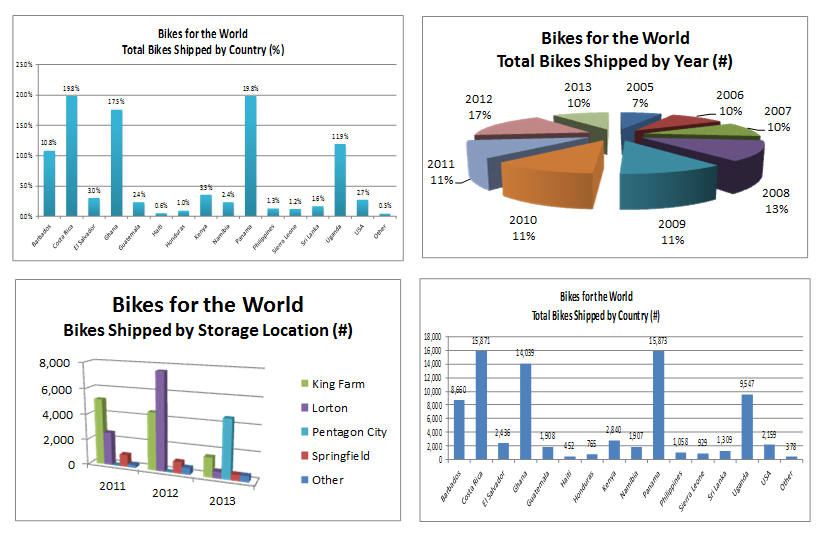
Even though we always count everything, we haven't been great about keeping track. That's what volunteer William Nickel does. We know that we've collected 80,131 bikes since 2005 (it's gone up since the last time we updated our counter on the website!). We know that we had a 51.9% increase in 2012 from the previous year.

We know that Costa Rica and Panama are currently neck and neck for the top dog slot of bikes donated from Bikes for the World with 15,871 and 15,873 respectively. But a shipment to Panama scheduled this month will secure their lead.

Bill got involved with Bikes for the World back when we were working with Pedals for Progress. He immediately saw what we were doing and the importance for good record keeping. From the onset he has been tracking our shipments and created a eloquent spreadsheet in Excel to do so.

He's learned a lot about Excel over the years and even had to upgrade out of the 2003 version just to add all the exceptions he needed to the formulas to create the different tables and graphs necessary to capture how many bikes we've donated to which partner in which country. He recently added Bikes Shipped by Storage Location to track where we were actually shipping from. And now with the click of a button we can create visual graphs that capture our progress.

Courtesy William Nickel
Bill wasn't just doing this for Bikes for the World, he created great record keeping systems for another organization too. Imagine our horror when we learned that Bill needed a break. We knew enough about Excel to add a column of data but what Bill was doing for us was a magical mystery.

Bill took the time to sit down with us and go over everything he set up. He went over Excel functions, how they worked, how to set them up, how to maintain the complex  =SUMIFS('Are You Kidding Me'!$E$6:$E$263,'I'm Going To Be Able To Do This'!$B$6:$B$263,"Complex Programming",'When We're Done'!$D$6:$D$263,"2013"). And at the end of his short in depth tutoring session, we got it! It all made sense. The tables he labored over setting up worked. They worked bike magic for us. I asked about breakfast and he laughed. I KNOW there is an Excel formula that will make breakfast for you....I just need to find out what it is.

It's a powerful program and Bill took the time to study it and find a good fit for Bikes for the World. Over the years he tweaked and perfected it. And he made it easy to understand and use. He got us our numbers quickly and allowed us to share them with you. We know how important this is...it's why it's featured on our home page. And if you meander further into our website you'll even find the exact worksheet we use.

William Nickel we cannot thank you enough for your years of service. Our helmets are off in appreciation. Best of luck to you; we'll see you on the bike trails.