Bikes for the World

Showing posts with label Bike shops. Show all posts

Wednesday, March 5, 2014

Top Shops

This month Bikes for the World would like to recognize our many shop partners who help give our donors a convenient location to drop off a bicycle year round...even when our community led collections are dormant.

In 2013 13% of our bike donations (about 2,000 bikes) came in through our local drop off points at our bike shop partners. We also worked with some of the same partners during our regular collection schedule to bring in another 500 bikes.

Race Pace Bicycles
Bikes for the World partners with 14 local shops in MD, VA, and DC all of whom collect bikes year round, issue receipts on our behalf, and store bikes until we can schedule a pick up. Some shops, like Race Pace Bicycles in Maryland and Spokes Etc. in Virginia collect at ALL of their locations and even transport the donated bikes to one shop so we can make one stop and collect about 60 bikes at a time. This makes scheduling our pick ups more efficient and helps us collect more bikes weekly.

Jan and Helen at Bikenetic
Many bike shops, especially in the DC area, are very cramped for space. Those who have warehouse space often have it off site from their actual bike shop, meaning any donations they take for us would need to be transported to another location and stored.

Some shops also save tires and parts for us, which can build up quickly, and as you can imagine mountain bike tires can really take up space. Our shop partners typically store these items for us for several months at a time. Donations to Bikes for the World require a significant commitment to space sharing by our shop partners, for which we are very grateful.

Many of the bikes coming to BfW through bike shops would otherwise end up in the local landfill or recycling bin. Once bike owners find out how much it would cost to repair an old bicycle some turn their attention to the sales floor. When they learn that their old bike could be helping someone live a better life it's often easier to part with their beloved bicycle.

The Mahleys donated two NEW bikes
In other cases, donors are drawn to the shops because they already know they want to donate a bike to Bikes for the World. It's not unusual to find a generous donor, especially around Christmastime, who will buy a brand new bike only to turn around and immediately donate it to BfW.

Last year the Mahleys brought two new Treks from Spokes Etc. that will be shipped out later this year. A mechanic from Race Pace bought and donated 10 new Kona bikes that were shipped to Kenya last year.

Dillard collection at Spokes Ashburn
Although our shop partners like to keep track of how many bikes they donate to us...Race Pace and City Bikes both donated over 500 bikes in the last three years and Spokes donated over 1,000...they are more than supportive of our community driven collections as well.

Some of our partners, like Pedal Pushers in Severna Park, host dedicated bike collections at their shops. All of our partners will help advertise another collection and sometimes give up their supply of bikes to help seed a local collection, like the Eagle project coming up at REI in Fairfax.

For a full list of our partnering shops and this month's BfW All-Stars visit our website.


Wednesday, July 10, 2013

The Right Tool for the Job

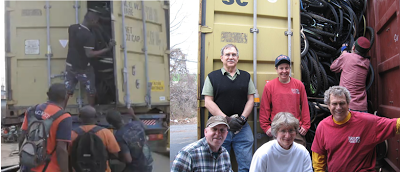
LEFT: Ghana. RIGHT: Springfield, Virginia. SAME container.
The Village Bicycle Project has been a long time partner of Bikes for the World. In fact over the last 8 years Bikes for the World has donated over 12,000 bikes to the project in Ghana and Sierra Leone making them our third largest partner (based on bikes donated). We have only donated more bikes to projects in Panama and Costa Rica, both now in the 15,000 range.

BfW bikes heading to Ghana's upper east region
BfW currently has containers on the way to the Village Bicycle Project (VBP) in both Ghana and Sierra Leone. Our last shipment to the project arrived in May and was unloaded into their new warehouse in Accra on the southern coast of Ghana.

From there, 240 bikes were transported north to the Upper East Region of Ghana where VBP was hosting a bicycle training program for three regions in June. To put the geography in perspective, the distance between Accru and Sandema, one of the villages where they were teaching, is 788 km or about 15 hours of drive time.

Basket weaver in Laabissi
For three weeks starting May 31, VBP would be teaching basic and advanced mechanics to villagers in three communities: Sandema, Nyobok, and Laabissi. The importance of the classes is to not only empower the communities that VBP serves, but to ensure that the bikes donated have a long, productive lives with their new owners.

Participants in the classes vary in age, occupation, and sex. In Nyobok, for example, VBP was shocked at the huge female turnout accounting for 72% of trainees. Most were farmers and then students.

Back in April VBP traveled to Laabissi and met the basket weavers who would be participating in the program taught in June. The bikes they received last month were all equipped with rear carriers to assist in carrying their finished baskets to market for sale. 80 women associated with this craft participated in the training programs in Laabissi.

VBP Program Coordinator Jason led the training programs alongside local trainers Sammy and Moro, both from the Upper East Region of Ghana. Not needing a translator made the curriculum much easier to deliver and grasp.

All participants paid a small fee to enter the program and received a bicycle from VBP for about $5 USD.

Upper East Region of Ghana
The landscape of this region is flat, dry, and very dusty. Everyone who took part in the Nyobok program requested 26" mountain bikes. You can imagine the maintenance that might be necessary to keep these bikes in good, clean working order. And as testament to the success of what is being taught, many of the bikes issued from the 2011 class were still in use.

Even more proof of how successful and anticipated the classes are can be seen in the attendance. Eager participants were gathered in Nyobok by dawn the day of training. The start time was supposed to be 8am, but they called for the trainers as early as 6am.

Later in the day, VBP offered a more in depth look into bicycle mechanics in their Advanced Class. Here participants learn skills like wheel truing and bearing assemblies. They are also offered hand tools at a 50% discount. There was such a huge turn out VBP ended up holding two classes instead of one and had to bring in more tools from the warehouse.

Jacob and Emmanuel came out to help VBP with training in Nyobok. Emmanuel's wife received a bike during the last training session. Jacob is in his early 20s and he also helped last time. The VBP trainers saw a huge improvement in his skills from before. Both local trainers were gifted with bicycle specific tools for assisting.

Pelungu is the nearest market town where bike owners go for parts and repairs. Francis, the local mechanic there, runs a large workshop with a staff of twenty. VBP is suggesting Jacob train under Francis to become an actual bicycle mechanic.

Young student learns how to loosen handlebars
VBP continues to focus on teaching females not only how to ride a bicycle but how to care for them. In Laabissi, one young woman caught the eye of trainers. 18 year-old Rita Putebil joined the Advance Class and volunteered for every demonstration and excelled in all the practicals.

Later that evening they invited her back and introduced even more specific tools such as the crank-puller and chain-breaker. Training with these types of tools is usually left for local bicycle repairers. VBP gave Rita her own set of tools before tasking her with the challenge of caring for the 80 bikes delivered to her community by VBP.


Dispatch 32: Simon, What We Learned from Ash Dumford on Vimeo.

Friday, January 18, 2013

Spares and Repairs

Ever wonder what happens to that container of bikes we load maybe at King Farm or Lorton?  You may have seen a lot of pictures of kids on bikes, bikes being used for work and school, bikes in shops supporting other non profit organizations overseas....but what about the actual containers?

Every single thing we ship overseas gets reused. It may be the bike, the OSB board we stack the bikes on, the rubber tubes and tires we use to level the rows, or YES, even the container itself.

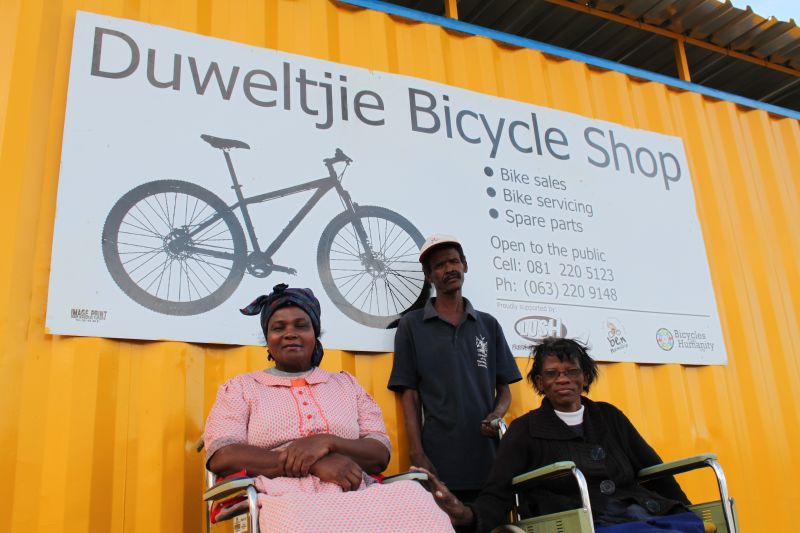
Bikes for the World's partner Bicycling Empowerment Network (BEN) has roots in Namibia and South Africa. BfW supports both programs.

BEN empowers local entrepreneurs with shipments of used bicycles and parts from organizations such as Bikes for the World and Working Bikes for example.

BEN not only supplies remote areas of Africa with bikes but also trains new bike mechanics, and offer business and computer classes to ensure new bike businesses flourish even in those remote areas of Africa.

This is what they call a Bicycle Empowerment Centre. Straight from the BEN website:

Through a partnership with a volunteer network, Bicycles for Humanity, BEN Namibia developed a new bicycle distribution model, the Bicycle Empowerment Centre (BEC). A BEC is a shipping container loaded with around 300 bicycles, spare parts and tools. BECs are delivered to the community based organisations that BEN Namibia works with and are run as bicycle workshops.

Each BEC uses its income from initial bicycle sales and servicing to ensure that it will be able to operate in the future, paying mechanics' wages, buying new spare parts, and covering the costs of resupply of bicycles. A portion of the bicycles are given to outreach volunteers or other beneficiaries like children walking to school, while a share of profits are used to fund community social initiatives.

 This isn't a 'set it and forget it' operation. BEN is a continual resource for these shop owners and mechanics. If a tricky derailleur comes in the shop, a mechanic, such as Mr. Bean (photo left), might go to the BEN training center to tap the knowledge of BEN's lead mechanic.

And the money raised through these bike shops isn't just a For Profit effort. Much of the proceeds go back into the shop to buy parts and bikes, but they also fund new entrepreneurial projects such as a concrete business that was started from BEC funds. 


Profits also support other non-profit efforts throughout Africa. The Tsumeb Bike shop supports the Tsumeb Hope Centre which feeds between 100-200 children daily.

Cycle 4 Life BEC in Mariental brings money in to feed children in the local Catholic AIDS Action orphan support programme.

As you can see a donated bike from a Northern Virginia garage can change more than just one life overseas. When we say your donations are changing entire communities, we mean it!

Sunday, July 1, 2012

Director's Letter to BRAIN

BfW volunteers at REI Fairfax Collection
Our last post about our work with local bike shops and the impact that has on the community reminded me of a recent letter to the editor from BfW Director Keith Oberg to Bicycle Retailer and Industry News (BRAIN). BRAIN is to the bike industry what the American Journal of Medicine is to medical professions.

BRAIN had done a piece on non-profits in the cycling industry in February 2012. The following is Oberg's response:

"Bikes for the World is the nation's largest bicycle reuse program--9,000 used bikes collected and donated in 2011, 60,000 since founding. We are creating a potentially significant model for raising the numbers of cyclists and the visibility of cycling at home and abroad.

Bikes for the World began as a project of the Washington Area Bicyclist Association (WABA) in January 2005. Operating initially under WABA enabled us to start up on a shoestring. We were operationally and financially autonomous from the beginning, but it also meant that we were operating "under the radar screen" invisible to many in the industry.

That is now changing. BfW just finished its seventh year operationally and first year as an independent nonprofit organization. With 9,000 bikes shipped in 2011, valued at $55 apiece, we handled about $500,000 in material donations, which went to nonprofit partners locally (e.g., earn-a-bike programs) and overseas to countries including Barbados, Costa Rica, El Salvador, Ghana, Guatemala, Kenya, Namibia, Panama, Philippines, South Africa, and Uganda.

Add to this the 5,000 bikes worth $275,000 that we shipped on behalf of the Chicago-based Working Bikes Cooperative--placing their bikes with selected, qualified overseas programs--and the total of bicycles handled comes to more than 14,000 bikes during 2011. We look forward to an even bigger year in 2012.

BfW is not only promoting cycling as transportation overseas; it promotes cycling here in the U.S. through working closely with the mid-Atlantic region's independent bicycle retailers. More than 20 area retailers host periodic donation events or accept donations of bicycles on our behalf on an ongoing basis. They also help owners of bicycles no longer meeting their needs to dispose of their unsatisfactory old bikes and make room to purchase high-quality bikes--bikes purchased at these participating retailers.

It's a terrific win-win situation. Not only do our donors, volunteers, and the cycling industry benefit here; people overseas benefit as well. Bikes that cannot be economically serviced here can be reconditioned overseas, generating employment and building a larger market for cycling."

Local shop partners: