Bikes for the World

Showing posts with label Africa bikes. Show all posts

Tuesday, June 2, 2015

New BfW Projects in Africa

 Bikes for the World is excited to be adding three new African partners this month. This week we will be loading and shipping two containers from our Arlington VA location. The first will be heading to Guinea-Bissau and the second to Madagascar.

Next week, Bicycles for Humanity- Oregon, WI will be loading and shipping a container of bikes to Cameroon, which Bikes for the World arranged and placed.

Global Fairness Initiative - Guinea-Bissau

In Guinea-Bissau our bikes will be distributed as part of the Guinea-Bissau Livelihood Initiative in Bafatá. This program aims to remove barriers to economic opportunity for small producers in one of the world's poorest and most isolated nations.

Bikes will go to a women's association of smallholder farmers who will sell them at affordable prices to their members to generate revenues for their micro-finance program. The bikes will help female farmers and their families transport good to storage centers, processing facilities, and markets.

Transaid - Madagascar

Transaid works to bring transportation solutions to poor people in developing nations. Transaid operates in several African countries, but our bikes will be used for their healthcare project in Madagascar. The hope is that bikes will help health workers access the villages and help others access needed services.

Transaid will help cooperatives of health workers to set up bikes shops. The members will receive training in bike mechanics and the revenues will provide them with an added incentive for their work and additional funding for health-related projects.

NAVTI Foundation - Cameroon

In Cameroon, our bikes will be sent to Ndop in the region of Kumbo, where the first of three bikes shops will be established. A bike mechanics program will train youth in the skills needed to repair and maintain bicycles.

Bikes will go primarily to students and small-scale entrepreneurs, particularly females, to promote economic development in the region.


Tuesday, March 11, 2014

Promoting Local Business

Rita Putebil Courtesy Jason Finch
Continuing our series on Village Bicycle Project (VBP) today we focus on the advanced mechanic class. Last year we introduced you to Rita Putebil, an 18 year old student who participated in the advanced class in Laabissi.

During training she asked questions and volunteered for every demonstration. She impressed the training team so much they stayed an extra day to show her further skills like pulling cranks and adjusting hub assemblies. VBP gifted her a set of tools and she is now maintaining the bikes in Laabissi.

Newly trained mechanics in Biama
Just last month VBP returned to the field traveling to three villages in the Brong-Ahafo Region. With the support of Re~Cycle VBP carried with them 260 bikes and 800 tools that would be distributed among participants in their workshops.

During the one-day workshops new bike owners learn every day maintenance and simple skills like how to fix a flat. People who have taken this class in the past are invited back for a more advanced mechanics class when the team returns. Some participants received their bikes over four years ago.

Local supply shop
Many local bike parts and supplies are very expensive, some hard to come by. Tubes and tires made for the American market are often of a higher quality rubber that they are preferred even used over the new tubes available in Africa.

This is why your donated parts, tubes, and tires are so important to Bikes for the World. We pass those on, packing them under cranks and between frames when we ship a container to Africa. VBP then ferries them across Ghana and into the local markets where your donated bikes end up.

New bike owners are taught only the basic upkeep of a bike in the one-day workshop. VBP trainers then pass along the local mechanic's contact information and encourage bike owners to visit them for the more extensive repairs. Promoting local business and mechanics is a high priority in the program.

Biama mechanic Maxwell
In fact during the recent visit to Biama, VBP trainers sought out the known local mechanic to invite him to the classes. They found Maxwell who was eager to participate.

Maxwell helped the trainers in class and then received further training that will help him in his business. He learned how to extract cranks, break chains, and adjust hub assemblies, just like Rita from last year. VBP also gifted him with a set of tools and promoted his business throughout the classes.

Biama, by the way, is known as 'the place where nobody will go'. Village Bicycle Project went, they taught, they conquered the complex workings of the bicycle and passed that knowledge on to keep your old bike rolling and in good shape. In case you were wondering, the 'rust' color in the photo above in not actual rust, it's Ghanaian dirt.


Wednesday, February 5, 2014

Giving Life To Your Old Bike

The last edition of our three part series on our beneficiaries in Kenya will focus on mechanics. Wheels of Africa teamed up with BfW partner BEN Namibia (BENN) to borrow their very successful BEC (Bicycle Empowerment Centre) model to set up shops that are accessible to everyone.

When bikes arrive in the container, they are in various stages of disrepair. They may merely need the pedals reattached, they will likely need a derailleur adjustment, but they might require a lot more maintenance, which is why they were donated in the first place.
In order for a bike organization to be sustainable and ultimately be chosen as a Bikes for the World partner, there has to be a plan in place for not only repairing the bicycles donated by us, but a method for maintaining them in the future.

BENN's BEC model is ideal because it trains and employs skilled local talent to become successful bike shop owners and mechanics. It also makes use of the bikes and parts donated by groups like Bikes for the World.

BEC owner Michael Otieno
BENN sent their most skilled mechanics to Kenya to help Wheels of Africa get this program started. Michael Otieno was trained in the Wheels of Africa program modeled after the original BECs of Namibia.

Mike receives bikes and spare parts through WOA. He will not only reassemble your old bikes but he will make sure they keep running for years to come. He also underwent specific entrepreneurial business training through the program to ensure his bike shop business remains successful.

Ousman Okoth
Ousman Okoth is a recent 'graduate' of the program and just established his own BEC. Both Mike and Ousman are training other youths to be mechanics and as well as successful BEC owners.

The BECs are situated in the suburbs of Nairobi. They are able to reach more remote villagers who are in need of affordable transportation to get to and from the city center for work, school, or health services. Mike and Ousman will not only get bikes into deserving hands but make sure those bikes keep working. They have apprenticeships that will help turn more Kenyans into skilled mechanics serving the communities where they live.

Bikes for the World is making an effort to increase the amount of spare parts we collect so that we are able to increase the value of our bike shipments by adding parts into every bit of space possible.

Recent partnerships with DC's Capital Bikeshare and NY's Citi Bike have brought cases of used parts, tubes, and tires into our warehouse that are in turn being shipped to support remote bike shops around the world.

Tuesday, February 4, 2014

Bikes For Community Health Workers in Africa

Yesterday we told you about how bikes donated in the DC area are helping a youth project in the Mathare Valley, Africa. Today we will introduce you to Kijiji Cha Upendo in Kibera where our donated bikes are helping bring affordable health care to AIDS patients in Kenya.

Through a unique partnership with Wheels of Africa (WOA) and the Tour d'Afrique Foundation (TDA) several organizations in Kenya are receiving bikes indirectly from Bikes for the World. This series will bring you stories from several of them as well as actual bike beneficiaries.

Courtesy Kijiji Cha Upendo
Kijiji Cha Upendo (KCU) is a community based organization in Kibera, one of the largest slums in Kenya and Africa. Kijiji Cha Upendo complements the efforts of families already providing physical and emotional support, to orphans and other vulnerable children, infected and affected by HIV/AIDS.

The organization provides workshops, loans, food, education, support and empowerment to families affected by HIV/AIDS. They also help educate the community about HIV/AIDS spreading a greater acceptance of those suffering from the disease.

Mary Syombua
Some beneficiaries who received bikes through Wheels of Africa are using them to help transport goods to be sold. This saves time and money and helps benefit the family as a whole.

"I used to transport green groceries from the market place to my small kiosk, deep in the slum. I would hire a cart from the stage to my kiosk for Kshs 50. These days, I use my bike from the stage to my kiosk. "
                                      Mary Syombua

Agrippina Andati
 Others, use the bike to help care for an ailing household member. The one thing KCU beneficiaries all have in common is the transformational change that has been brought about by the bike. Some of these beneficiaries are infected with HIV/AIDS; all are all guardians to either orphans or vulnerable children.

Agrippina Andati uses her bike to pick up medicine for a sick relative. The money saved by using the bicycle allows her to better care for her relative. Agrippina does not know how to ride a bike, but her children use it to run these errands for her.

                  Ol Kalau Hospital Health Workers
Another health related project supported by WOA (and BfW) is in Ol Kalau, the central region of Kenya. Alongside the Peace Corp, Wheels of Africa dedicated ten bicycles to Ol Kalau District Hospital.
 
Bikes are used by these community health workers (left) to ensure that residents of Ol Kalau receive medication and treatment in collaboration with the district hospital and Peace Corps.


Tuesday, September 10, 2013

The Fourth 'R': Riding

How exciting. Today we are talking about two new areas where Bikes for the World bikes are ending up in Africa. Cameroon and Mozambique. And to be even more specific we can say some of those bikes came from Severna Park and Arnold Maryland.

Two new education projects are receiving bikes through Bikes for the World. Many of the bikes included in the two shipments came from Pedal Pushers and Bike Doctor Arnold, both long time Bikes for the World shop supporters.


Courtesy ChildFund Mozambique
From Director Keith Oberg:

Keeping kids in school is one of the most productive investments that a society can make. Recognizing this premise, Bikes for the World provides students at risk of dropping out the means - in the form of a bicycle - to arrive at school on time, refreshed, and with time savings, thus enabling them to study more, do chores at home, and stay in school.

Providing bikes for education has happened to one degree or another in all of our supported projects going back to our start in 2005. Beginning 2011, however, we supported a 100% education project, Bikes for the Philippines.

Courtesy Wheels of Africa
Now, following on this project's initial success, we are looking for new opportunities to support education, and are particularly interested in Africa, where millions of children drop out of school, especially at the critical transition from village-based primary school to regional secondary schools. The loss of human potential is immense.

Two countries where we are exploring the role of bicycles in education are Cameroon and Mozambique. In Mozambique we will be working with ChildFund International to help distribute bikes to school children and teachers in central Mozambique. The first container is scheduled to be loaded at our Arlington warehouse September 14-15.

Courtesy BIG
Recently a small shipment of bikes, about 30, were sent to Cameroon, piggybacking on a shipment of books by a local Rotary club. The shipment of books and bikes was sponsored by the Cameroon Education Foundation in Kumbo, an English-speaking area in northwestern Cameroon close to the Nigerian border.

Almost all the bikes shipped this past spring have already been reconditioned and given to students in Kumbo. One such student is Alhaji Suleman, a student of GBHS who lives in Rogasah Kumbo.

Friend of Alhaji Suleman
"I will like to thank Bikes for the World for sending bikes to Cameroon for the first time. Like my friends I love bike because it will help me go to school easily.

"[The bike] will help my moment to school which you know is far from my home. Secondly the bike will reduced my transport cost. Thirdly the bike help me to travel in and out of Kumbo."

Alhaji Suleman, bike beneficiary, Kumbo Cameroon.

Wednesday, July 10, 2013

The Right Tool for the Job

LEFT: Ghana. RIGHT: Springfield, Virginia. SAME container.
The Village Bicycle Project has been a long time partner of Bikes for the World. In fact over the last 8 years Bikes for the World has donated over 12,000 bikes to the project in Ghana and Sierra Leone making them our third largest partner (based on bikes donated). We have only donated more bikes to projects in Panama and Costa Rica, both now in the 15,000 range.

BfW bikes heading to Ghana's upper east region
BfW currently has containers on the way to the Village Bicycle Project (VBP) in both Ghana and Sierra Leone. Our last shipment to the project arrived in May and was unloaded into their new warehouse in Accra on the southern coast of Ghana.

From there, 240 bikes were transported north to the Upper East Region of Ghana where VBP was hosting a bicycle training program for three regions in June. To put the geography in perspective, the distance between Accru and Sandema, one of the villages where they were teaching, is 788 km or about 15 hours of drive time.

Basket weaver in Laabissi
For three weeks starting May 31, VBP would be teaching basic and advanced mechanics to villagers in three communities: Sandema, Nyobok, and Laabissi. The importance of the classes is to not only empower the communities that VBP serves, but to ensure that the bikes donated have a long, productive lives with their new owners.

Participants in the classes vary in age, occupation, and sex. In Nyobok, for example, VBP was shocked at the huge female turnout accounting for 72% of trainees. Most were farmers and then students.

Back in April VBP traveled to Laabissi and met the basket weavers who would be participating in the program taught in June. The bikes they received last month were all equipped with rear carriers to assist in carrying their finished baskets to market for sale. 80 women associated with this craft participated in the training programs in Laabissi.

VBP Program Coordinator Jason led the training programs alongside local trainers Sammy and Moro, both from the Upper East Region of Ghana. Not needing a translator made the curriculum much easier to deliver and grasp.

All participants paid a small fee to enter the program and received a bicycle from VBP for about $5 USD.

Upper East Region of Ghana
The landscape of this region is flat, dry, and very dusty. Everyone who took part in the Nyobok program requested 26" mountain bikes. You can imagine the maintenance that might be necessary to keep these bikes in good, clean working order. And as testament to the success of what is being taught, many of the bikes issued from the 2011 class were still in use.

Even more proof of how successful and anticipated the classes are can be seen in the attendance. Eager participants were gathered in Nyobok by dawn the day of training. The start time was supposed to be 8am, but they called for the trainers as early as 6am.

Later in the day, VBP offered a more in depth look into bicycle mechanics in their Advanced Class. Here participants learn skills like wheel truing and bearing assemblies. They are also offered hand tools at a 50% discount. There was such a huge turn out VBP ended up holding two classes instead of one and had to bring in more tools from the warehouse.

Jacob and Emmanuel came out to help VBP with training in Nyobok. Emmanuel's wife received a bike during the last training session. Jacob is in his early 20s and he also helped last time. The VBP trainers saw a huge improvement in his skills from before. Both local trainers were gifted with bicycle specific tools for assisting.

Pelungu is the nearest market town where bike owners go for parts and repairs. Francis, the local mechanic there, runs a large workshop with a staff of twenty. VBP is suggesting Jacob train under Francis to become an actual bicycle mechanic.

Young student learns how to loosen handlebars
VBP continues to focus on teaching females not only how to ride a bicycle but how to care for them. In Laabissi, one young woman caught the eye of trainers. 18 year-old Rita Putebil joined the Advance Class and volunteered for every demonstration and excelled in all the practicals.

Later that evening they invited her back and introduced even more specific tools such as the crank-puller and chain-breaker. Training with these types of tools is usually left for local bicycle repairers. VBP gave Rita her own set of tools before tasking her with the challenge of caring for the 80 bikes delivered to her community by VBP.


Dispatch 32: Simon, What We Learned from Ash Dumford on Vimeo.

Monday, July 8, 2013

Where Is Your Old Bike?

NOVA Meet Up group loading at Springfield in March
Did you donate a bike at REI last spring in Virginia? There is a good chance we can tell you exactly where it went! Donors often ask where their bikes are going when they drop them off with us, but we can rarely pinpoint it at that particular moment. If you continue to follow our progress, however, you might just find out...OR better yet even see your bike!

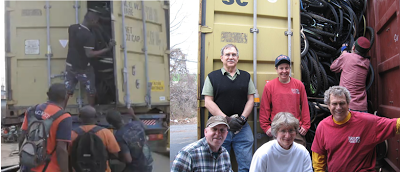
Team in Ghana who unloaded the container
Back in March we loaded a container bound for the Village Bicycle Project in Ghana. We were cleaning out our Springfield trailers and the NOVA Meet Up group (photo above) came out to help us finish the load.

Two months later the container was in Accra being unloaded by the crew to the left. The Ghana team is Moro, Abokyi, Jason, Sammy and Tofic with local retailer Adi, outside the new warehouse. This was the day before our container arrived...the first one to be unloaded into the brand new warehouse.


Earlier the same week the Village Bicycle Project moved what was left in the old warehouse to their new permanent one in Accra. From their facebook page:
After relocating bicycles in Ghana for 13 years, and working out of multiple lockups and storage units, we finally signed the deed on our own warehouse space. Centralizing our distribution means we're going to be better prepared and much quicker at responding to applications.

A huge thank you! to all our supporters who helped make this happen! Today we moved 200 bikes from one of our importers and worked long into the night. We're all pretty exhausted...
Then came the container from Bikes for the World Springfield, Virginia.

Once again, here's the recap:
March 15, 2013- You uncovered your unused bike in your garage to donate Saturday

March 16, 2013- Your old bike was donated at REI in Fairfax Virginia

March 18, 2013- After being loaded onto a shipping container earlier that weekend your old bike was transported to the Port of Baltimore where it would leave on its sea journey to Africa

May 16, 2013 Village Bicycle Project finished moving their warehouse contents into a new facility in Accra Ghana

May 20, 2013 The Ghana team seen above was gearing up for our container the next day

May 21, 2013 Bikes for the World container was unloaded into the new warehouse in Ghana

May 25, 2013 Some of those bikes were transported to Ghana's Upper east region for a training program

June 17, 2013 Bikes sold to participants in the program for $5.00 USD (update on blog coming soon)

You gotta love facebook. We are getting real time updates from some of our partners. Don't believe me? You can watch the whole container being unloaded right here (you might even see YOUR bike):


Dispatch 36: Container Unloading from Ash Dumford on Vimeo.

Sunday, June 9, 2013

A Perfect Record

BfW shipment to Wheels of Africa, Kenya
Each country we ship to has a different set of rules and regulations. And the cost of shipping varies from one location to the next. A country such as Panama might only cost a few thousand dollars to ship a container of bikes while Uganda will cost three times that.

One of the reasons we choose our international partners carefully is to ensure our shipments arrive safely. One of our main criteria is that they have a proven track record of getting shipments successfully into the country. A hang up could be the port authority or government, and that could create insurmountable issues clearing customs.

Shipments going into Kenya and Uganda both pass through the Kenyan port of Mombasa. You can see from the map to the left that Uganda is still very much inland from this port. A container of bikes from the Port of Baltimore to Mombasa may cost $5,000 US. However, to move those bikes from the Kenyan port to Uganda by truck will cost another $4,000.

If the government were to impose an import duty on these donated shipments, those costs could soar upwards of $15,000, for a container of 500 used bikes! This could impact our relationship with Uganda. And this is where we are now.
Courtesy Prisoners Support Organisation

In fact, our latest shipment to Uganda suffered an even worse scenario. This was our 27th shipment to the Prisoner's Support Organisation (PSO) in Uganda. When it arrived at the port of Mombasa, it was pulled aside by the Kenya Revenue Authority (KRA). Up until recently, we had no major issues clearing the port and moving inland, via truck, to the Ugandan capital of Kampala. This time, however, the PSO's shipping agent was told that the KRA had determined that our shipment was mischaracterized on the bill of lading-the critical shipping document-and that we would be fined, held responsible for the costs of unloading and verifying contents, and charged for storage. The alleged issue was that the KRA considered the bikes to be 'assembled', and not 'semi-disassembled', as we have consistently stated on our shipping documents.

May shipment of BfW bikes in Ghana
Upon learning of the problem from our local partner, PSO, we responded that the KRA position was in error, that our bikes-with their pedals removed, their handlebars turned and rotated, seats down, and sometimes with wheels removed-were indeed 'semi-disassembled' as stated on the bill of lading, and that neither we nor the consignee were responsible for any costs incurred. "Try and ride one of our compacted bikes!" If they were not ride-able, they were surely not assembled.

BfW shipment of bikes arriving in Colombia
A few weeks later, we received the gratifying news that the KRA-which has inserted itself into a matter we considered best left to Ugandan authorities-had dropped the fine and associated charges, and the container had already proceeded on to Uganda.

After 150 shipments, going back to 2005, we have never yet 'lost' a container (and its contents) to abandonment and confiscation.

In large part, this is due to the commitment and competence of our receiving partners, who research import requirements, hire a freight agent, and move quickly to clear the container from port before storage costs begin to mount up. Another reason is that Bikes for the World commonly requires that its receiving partners pay a portion of direct costs ahead of time, making them 'invested' in the shipment and motivating follow up.
May BfW shipment to Village Bicycle Project, Ghana

Monday, April 22, 2013

A Twist: Bringing Bikes BACK From Africa

In honor of Earth Day, a post about why I love my bike! In an odd twist, this bike was actually imported from Africa, instead of the other way around.

Bikes for the World collects and ships over 10,000 bikes annually in and around the DC area. Many of these bikes end up in Central America and Africa. In fact, last year alone, BfW shipped over 13,500 bikes to about a dozen countries, including the Philippines.

Bikes for the World operates to make quality used bicycles and parts affordable and available to lower income people and select institutions in developing countries to enhance their lives and livelihoods through better transport. BfW also places a high emphasis on the bike's ability to generate employment especially through bicycle repair and maintenance.

Courtesy Zambikes
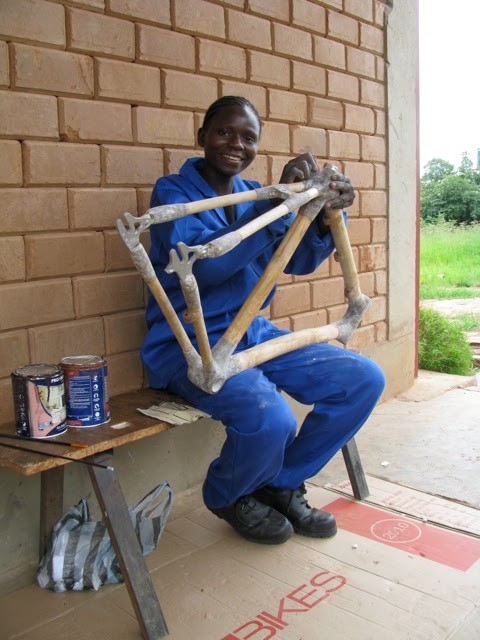
Another group interested in a similar focus is Zambikes in Africa. The Zambike mission is actually dedicated to saving lives by connecting villages to critical medical treatment in Africa through transportation solutions. Their focus: The Zambulance.

Zambikes creates local jobs by creating and building locally, in Zambia and Uganda, high quality, affordable bikes built specifically for African roads. They also build specialty carts to haul product and people. Oh, and let's not forget  bamboo bikes, built using locally grown and sustainable materials for the global market.

If you've been to a BfW event, especially a 'green' event, you may have seen my Zambike in person. It's made with bamboo, hemp, and resin and it's a great ride! People always stop and ask about it, some telling me about their failed attempts to make one of their own. I've had this bike for about two years now and it's held up great. It rides a bit like steel but without the weight. It absorbs the bumps in the road and smooths them out in way unlike aluminum. It's absolutely perfect for the city bumps in and around DC. The frame itself weighs about 11 lbs.

More importantly this bike, and others like it, creates employment for over 35 Zambians. Below you can see John cutting the bamboo from a field, Danny baking it for strength, Mazimba working the jig, Esnard affixing logos, and Stain (I'm guessing a nickname) spraying the final product.
JOHN courtesy Zambikes
DANNY courtesy Zambikes


MAZIMBA courtesy Zambikes
ESNARD courtesy Zambikes


STAIN courtesy Zambikes

Tuesday, March 5, 2013

The Kennedy Center Sends Bikes To Africa

Volunteers from Sasha Bruce help load Kona bike
We recently told you about a unique bike donation coming in through partner bike shop Race Pace in Columbia. 10 brand new Kona Africa bikes were purchased and donated by a part time mechanic; these bikes are currently on their way to partner program Wheels of Africa in Kenya.

We also told you this wasn't the first time this donor generously donated new bikes. A few years ago Norm donated several one speed versions of this Africa Bike. You can read more about this year's donation on our blog OR watch the video.

Muwonge Jalia
Muwonge Jalia received one of those bikes Norm donated last time. She is a widow with 5 children. She is also a member of the Nakyesa Widows and AIDS patients farmers groups in the Kayunga district.

Most of the farmers in the Kayunga district borrow Jalia's bicycle to travel to the markets, health centers, and for personal errands. The proud owners of these new bikes shipped by Bikes for the World refused to remove the cardboard packing from the frames in an effort to keep them unscratched and protected even as they started using them for work.

 If you watched the video you heard Norm ask about other people donating NEW bikes and saw another one that came in through Spokes Etc in Virginia.

Then we remembered another unique donation that came in a couple years ago after the maximum India program at the Kennedy Center.

28 bikes were donated to BfW from the Kennedy Center
We were contacted by the Kennedy Center as their international festival featuring India was winding down. They had 28 sturdy Indian made bicycles on display during this festival that celebrated Indian culture and art forms. They were interested in donating all the bikes to Bikes for the World.

There were some adult tricycles and bicycles with heavy duty racks you see to the left. Here the bikes are waiting at our Lorton facility before being shipped to Uganda fall 2011.

Fred Musunda
Well late last year we got this story back from Uganda about Fred Musunda, the owner of a brand new Atlas bike (indeed, the same one you may have seen on display at the Kennedy Center!)

In Uganda, milk plays an important role in food security and the fight against malnutrition.  Fred Musunda collects milk from rural farmers in Matugga (about 15km from the city) and transports it to the urban markets and individual households.

Farmers in rural areas have turned to collectors with bicycles to transport the milk and ghee (butter) they produce. Fred bought a bicycle through the Prisoners Support Organisation to help him deliver fresh milk and ghee to his customers.
Fred bought a new Atlas from PSO

Unfortunately his Avon bicycle (seen above) was worn out, limiting how much milk he could transport to his customers. After visiting the PSO Bike Center Fred was able to purchase this brand new Atlas bike (seen left) with a rack big enough to handle the 40 litre containers of milk he had become accustomed to carrying.

He noted that since it was a rainy season, the milk production was high and yet the roads in Matugga were impassable and only bicycle riders could access farmers. Bicycles play a big role in the milk collection industry since most roads out of town are not easily accessible by motor-vehicles. There are about 35 milk collectors in this area who sell locally produced raw milk and dairy products to theurban markets/trading centers. 

This Atlas bike is one of the very same bikes seen above at Lorton and donated by the Kennedy Center in 2011.  And although Keith, Phil, Yvette, or Nick (all of whom helped pick up (literally) these bikes from DC and made sure they made it in the container for Uganda) will tell you these bikes weighed a ton, Fred Musunda will tell you it's perfect! He is the envy of other milk collectors in the area who all want a similar bike to his. He also noted that his weekly profits doubled after purchasing his new bike.