Bikes for the World

Friday, August 4, 2017

One Bike, Two Wheels, Four Revolutions

This story of change begins with the bike, but it doesn't end there. Our donated bikes are helping to improve lives in so many ways in Costa Rica it's hard to keep track of them all. 

For you, that bike you donated may represent memories of fun times on the trail, easy commutes to work, or a milestone in your child's life when she took her first solo ride toward independence.

In Costa Rica that one bike might represent a ticket to improved education for a student, a job for a local mechanic, a tool for a struggling family, and a financial loan to improve a small business. 

FINCA Costa Rica has been working with Bikes for the World since 2005 to bring bicycles into small rural villages to improve transportation needs. But that wasn't the final goal of bringing bikes to these communities. Find out how your donated bikes are changing lives on two wheels and off in this short series highlighting the stories of five local entrepreneurs.

Maria Ignacia lives in a community known as Canalete in Upala, Costa Rica. She is part of the Community Credit Enterprise (ECC) that our partner FINCA Costa Rica helped establish. The ECC has over 100 members and each member has the ability to apply for a small business loan to help improve their productivity. 

Our bikes serve as the capital needed to grant these loans to members of the co-op. If an ECC requests a container or partial shipment of bicycles they prep our donated bikes for use and sell them among the community or to their neighbors. Each bike is sold for between $10-100 depending on the quality of the bike. The proceeds then get folded into this general fund for use among the community to improve their businesses, or sometimes to get a new one started.

Maria applied for a loan to help build a chicken coop to protect her main source of income for her family...egg production. She has been raising chickens and collecting eggs for the past year. She collects the eggs and sells them throughout the community to help provide for her and her family. 

FINCA helped facilitate the $1,800 loan she needed to build a small chicken coop. Her chickens are now better protected from the elements and their productivity is much improved. Maria now has more money for her family even while she works to pay back the loan to the ECC.
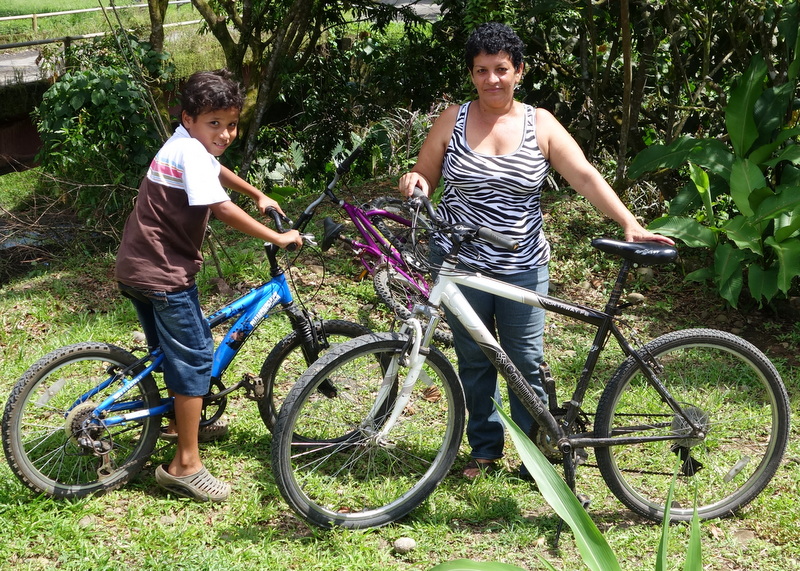
Tonito and Eduviges

Tonito and Eduviges are not related but both live in the same community as Maria, Canalete. Both received bikes from our shipment to this community in 2014. We had a chance to meet them when we visited the community that fall and even rode with Tonito through the community. 

Eduviges bought her bicycle through the co-op and she uses it to commute to work. Eduviges works on a lychee farm and used to get up at 5am to walk the two hours to the lychee field. She can now cover the same ground in less than half the time, saving time and energy.

Tonito is from a very poor family that lives in Nicaragua. They sent Tonito to Canalete to live with his grandfather in hopes of giving him a better life. The co-op members decided to give Tonito a bicycle and helmet to reward him for getting such good grades in school. 

Tonito was also on hand to help unload the bikes that were donated to the community and helped organize and prep them for sale. The sale of those bikes, including Eduviges's, may have helped provide the loan to Maria for her business.


Tuesday, August 1, 2017

Featured Volunteer: Margie Ligon

This month we head back down 95 South to our partners in Charleston, to recognize this month's volunteer Margie Ligon (here on the left).

Margie worked with the Youth Ministry at Philadelphia United Methodist Church in Fort Mill, South Carolina....barely....this is nearly on the North Carolina line, quite a distance from our warehouse in Charleston.

Here at home in DC, if someone had contacted us hoping to do a collection nearly 200 miles from our warehouse HQ we may have been forced to turn down the offer.   The strain on our resources may have been too great.

But when an entire United Methodist community comes together and offers a statewide challenge...you tend to pay attention and make exceptions.

And that is what brought Philadelphia UM and Margie Ligon and us together. Margie heard about Bikes for the World through a state UM conference where their Bishop offered up a challenge. He was asking each district to collect XX number of bikes (we don't know the actual number, but as Margie tells us it was not aggressive enough for her).

"I felt like my church by itself could collect what he was expecting an entire district of 66 churches to collect," thought Margie. Never one to sit back and wait, Margie cut to the chase, she contacted us directly here in DC and said, how do I get our church on your calendar?

We connected Margie with our area coordinator Paul Keefer in Charleston and the rest is sort of history.

She recruited the youth volunteers you see above to help collect and prep the used donated bikes. She also engaged the Youth Ministry in a fundraiser to help raise money to buy new bikes to supplement the donation...there was no way she was falling short of the Bishop's goal.

In fact Margie waged her own goal within their congregation, 200-300 bikes. What did Philadelphia UM end up collecting this spring? 289 bikes.

Charleston BfW bikes in Costa Rica
The youth group along with assistance from the men's group bought and assembled 114 brand new bikes to be donated among two BfW partners, CESTA in El Salvador and MiBici/FINCA Costa Rica.  But the outreach in the community also brought in 175 donated used bikes!

To quote BfW Coordinator Paul Keefer, "Margie don't mess around."

Those nearly 300 bikes were shared among two containers shipped in April and June from our location in Charleston. The first arrived in El Salvador and the second was shared among community groups in rural Costa Rica.

CESTA trained mechanic Cristian Martinez
In Costa Rica, bikes were sold to rural residents needing transportation for work and school. Money raised will help support many local businesses in the form of loans to increase production.

In El Salvador new mechanics like Cristian learn skills that will help them professionally to earn more for their families.

"I learned new skills, things I never did before, earn money, and also encouraging me to realize I could take on new challenges in other fields," Cristian Martinez.

Margie moved on to First United Methodist Church of Belmont North Carolina where she was recruited to help the Youth Ministry there. From what we've seen at BfW when Margie puts her mind, heart, and soul into something she affects positive results. We have no doubt there are great things in store for Belmont. And we hope to partner with Margie again soon.

Wednesday, July 26, 2017

We've Been Invaded By Canada....Again

DC Serve Canadian/Michigan based crew
Joining forces with volunteers from around the globe, Bikes for the World kicked off July by desperately trying to empty out the warehouse to make a little room to move around. We failed, by the way. Still stacked to the rafters with bikes, which is not a bad problem to have because it means more bikes to donate!

BfW, keeping with our annual tradition, welcomed two crews from DC Serve to help load the first container of bikes heading to Costa Rica. The crews, largely from Canada, worked through one of the hottest weeks of the year to start and finish a container on back to back days.

Cypriots welcoming the Birzers from the Carroll Creek Rotary
Then, just when we thought it couldn't get any hotter, it did. The following week we brought in another container and welcomed back the Cyprus Friendship crew, who hasn't visited us since we left King Farm. Now that we are back in Montgomery County we were thrilled to have a group of six girls back with us again from this amazing program.

Cyprus is located in the Eastern Mediterranean  with Turkey to the north and Greece to the west. Cyprus is divided in two with Turkish-speaking Muslims on the north and Greek-speaking Christians on the south. This deeply divided nation has been at odds for generations and Cyprus Friendship Program is one way they are trying to change attitudes and bring a more peaceful future to its people.

The program pairs two girls (or boys), one from the north and one from the south, and challenges them to work together, live together, laugh together: ultimately creating a bond they will hopefully keep upon their return home and serve as an example to their families and friends. A catalyst to change. They spend one month here in the US with host families and participate in numerous peace focused workshops.

When they visited us, we put wrenches in their hands and put them right to work. At the beginning of our day we asked if they had ever worked on a bicycle before and they collectively said no. By the end they were tearing through our bikes like seasoned bike mechanics. We apologized for the sweltering, muggy DC heat wave that plagued their visit and they said, no worries, it's just like home!

Not to create any rivalries here in our  bipartisan warehouse, but it was no contest between the Cypriot youth when asked which is better, Baltimore or DC. On the topic of healthcare, the Canadians said, good luck with that, we're good. It's a small, small world here in our warehouse.

Bikes for the World has nearly 1,000 bikes now on the way to Costa Rica to share among about half a dozen urban and rural communities. These bikes will provide much needed affordable transportation for work and school, but they will also be part of a bigger economic impact we will tell you about in upcoming posts. Check back soon...

Saturday, July 8, 2017

Bikes for Sierra Leone

Bikes for the World partner Village Bicycle Project (VBP) operates bike programs in both Ghana and Sierra Leone in Africa. We started shipping bikes to VBP-Ghana in 2005 and added Sierra Leone in 2012. Between both projects we have donated nearly 20,000 bikes since 2005.

Our first container load of 2017 went to Sierra Leone and was received and distributed earlier this spring. Just like the bike workshops we told you about in Ghana, bikes distributed in Sierra Leone followed the same structure. Participants are often selected by community leaders and take part in a one day workshop where they learn how to properly clean and maintain their bikes. They are also taught riding skills and safety in this workshop.

The first of our bikes were taken to Makambo Village and distributed to workshop participants. Over 25% of the bikes went to women and school girls.

On to Konta Wallah. This village is an island in the northwest corner of the country with a population of 700 people and is largely focused on rice farming.

Here 20 farmers and 5 students joined VBP and learned essential bike care in the program. At the end all were awarded a bike through the program. The residents of the town are still dependent on motor boat transportation to and from the island but the new bicycles will better allow them to travel around the island and access their farms.

Finally Binkolo, where VBP continues to work with St. John's Secondary School to ensure every student who needs a bike for transportation to school gets one. VBP worked first to get bikes for the students farthest from school.

Community organizer Justin explained, "Education is one of the challenging issues in this community. We only have one secondary school. Some students have to walk nine miles, that's 18 miles round trip- five hours of walking every day. A lot of students drop out of school."

VBP ED Joshua Poppel and Magdelene
Magdalene is a student at St. John's and she received her bike this year. "I was struggling coming from my village. I was coming late (to school) but when I have this bicycle, I would say I am the first one to be here. I am very happy and proud."

VBP has been back to St. John's several times already this year. In June VBP reported this, "a new shipment is now on its way to deliver hundreds of bicycles to Binkolo Village, Sierra Leone. When they arrive, our staff will help distribute the bikes to students and adults, some will be used in our mechanic training and others in our learn-to-ride programs."


Friday, July 7, 2017

Bikes for Ghana

This week we loaded our second container this year bound for Village Bicycle Project (VBP) in Africa. Our first was distributed to Sierra Leone and this one will head to Ghana.

Earlier this spring BfW bikes donated last year to Ghana were loaded onto smaller trucks and transported to rural areas of the country. The bikes were introduced to their new owners through VBP's Preventative Maintenance Workshop.

When container shipments of bikes come into Ghana they are offloaded and stored at VBP's main warehouse in Accra. They are then loaded onto smaller trucks and transported many hours to remote villages all around Ghana.

This particular shipment included 80 bikes donated by BfW. The bikes were transported to two different communities, one in Lawra and the other Kalsagri.

After a two day journey, the bikes arrived on site where three staff members and six trainers were ready to teach the workshop to eager villagers ranging in age from 13 to over 60. Each participant was chosen by community leaders. and represented workers, farmers, and students.

The mechanics would take a day to ready the bikes for the class. Participants in the workshop would be learning basic maintenance and care, like how to keep the chain free of grit and how to repair a flat tire.

Simon is a local mechanic
If someone signed up and didn't already know how to ride a bike, VBP staff members would also teach bike handling skills in this class. Since many guys already know how to ride, VBP started offering women specific classes, where they have a more relaxed setting to work with those novice riders.

One last detail of the class needed to be worked out before beginning. For each workshop offered throughout Ghana, VBP identifies and recruits local mechanics to assist at the workshop. This helps establish a relationship between the new bike owner and their local mechanic who will help them going forward with spare parts and more complicated repairs.

This spring, they brought on two local mechanics to help with training.  For their support VBP rewards each mechanic with a specialized tool set. Participants in the class would be going home with a bike. Each participant pays less than $25 for the workshop and bike.

From VBP: "This donation was very helpful to meet the critical needs of some people in Ghana's rural north. It was especially important for school children who have had to walk over eight miles to and from school every day."

They also report that the task of monitoring and evaluating the beneficiaries is a priority for VBP staff. They will continue to check in on, especially the students, to see how the bikes are affecting their studies.

The breakdown of BfW specific beneficiaries in these two villages are as follows:
     42 students
     15 small scale entrepreneurs
     22 farmers
       1 teacher


Thursday, July 6, 2017

Catch-22, Meet Force of Nature

Mary Wiiyor is a young mother who took part in a Village Bicycle Project (VBP) Preventative Maintenance Workshop several years ago in the upper west region of Ghana.

Back then Bikes for the World Ghanaian parnter VBP noticed an important distinction...women really needed bikes, but many didn't have them. Some had never learned to ride a bike. Others kept having their bikes stolen from their male relatives or even other boys in the village.  It was a gender biased Catch-22.

So VBP devised a plan to empower these women one spoke at a time.  First they would teach them to ride a bike. Through their already established workshops, VBP staff and trainers could reach rural women and get them up and rolling on two wheels. Once a girl knew how to ride a bike her whole world opened up to change.

With her new riding skills a young woman could borrow her brother or father's bike and run errands more efficiently, maybe to go get firewood in the evening. Or to carry heavy loads of water.

All of a sudden these chores became, dare we say, fun. It definitely saved time and enabled her to carry more wood. It also allowed her to skip the dangerous practice of head loading, where women carry extremely heavy loads on their heads, sometimes injuring their necks and backs.

Meanwhile, VBP continued training men and supplying them with bicycles. And eventually the guys stopped stealing the women's bikes. Maybe they all had their own bikes. Or maybe they saw the benefit women brought to the family once they had bikes.

Regardless, VBP started offering bikes to men and women at all their clinics. And what they found was increased productivity in the village. Kids were going to and staying in school. Farmers increased crops. Budding mechanics found work.  And bikes just kept rolling year after year.

What they also learned is the girls really loved the work. They were good with their hands and were proud to own a bike. They learned how to properly clean and maintain their bikes. They could change a tire. Tweak their brakes. Some even learned more intricate skills to repair bikes.

Eventually, VBP started to offer women's only classes. Here the trainers could focus more directly on what the women really needed to improve. Without the, sometimes domineering, men around,  women were in a more relaxed space where they felt more comfortable asking questions and moving at their skill level and pace.

At the end of the class, the women received: a wire brush, screwdriver, tire levers, lube, a tube, and a pump. Oh, and a bicycle and the skills to ride it!

Today, Selina Abuakwa is not only the proud owner of her very own bicycle, but she knows how to ride and maintain it. Since receiving her bicycle from VBP in April of 2016 she is now financially independent.

Selina uses her bicycle to get to work and also for work. Her farm is about four miles from her house and it used to take her two hours a day to walk.

She now does that commute in under 30 minutes and uses the time she saves to grow more cassava! She also uses the rack on the back to carry the cultivated cassava directly to her customers.

With the saved time and extra income not only is Selina's life improved but so are the lives of her three children.

To borrow the phrase from REI Co-Op, Selina Abuakwa is a true Force of Nature.

Sunday, July 2, 2017

Featured Volunteer: Larry Silverman

Who is Larry Silverman? "I've been around the BfW warehouse for years and I've never seen this guy."

Perhaps. Larry Silverman IS BfWNY. New York City!?! Not quite, but you get the idea. So you may not have seen him around Arlington or Rockville, but this guy is swimming in donated bikes.

And truth be told, you may have seen him once down in Arlington when he came during an inauguration service event several terms ago.... Since that visit our work sort of stuck with him.

Then back in the winter of 2014 he contacted us and said, how can I get more involved. BTW, I'm in Long Island. So we thought we'd offer him a challenge to be an area coordinator. And he said, I'll see your challenge and raise you a warehouse. That's right, Larry tackled the biggest hurdle right off the bat, he found space to hold bikes, hundreds of them.

Next we connected him to a scout hoping to work with us on an Eagle Project and the bikes started pouring in. There were several more collections, a New York based youth group, Recycle-A-Bicycle, Citi Bike New York...we seemed to be getting bikes from every direction and boxes and boxes of parts.

Director Keith Oberg left the office one day and went for a long drive to think about what to do with all those bikes in New York. Or maybe he had already scheduled a loading from that location and drove up there to mentor Larry in how to load a container. Yeah, maybe that was it.

Regardless, here this new volunteer area coordinator found himself swamped with bikes and loading his first container to be donated to Village Bicycle Project Sierra Leone. And we found ourselves with a first time loading from New York, how exciting!

This past spring after almost a year hiatus, we got the call again. Kenny Marx was up to good again; he wanted to collect bikes at PortFest as he had in previous years. We called Larry, who said sure, I'll drive a truck, lend a hand, and add these bikes to the warehouse!

Little did he know Kenny would more than double the number of bikes he typically gets at this collection. And it would be cold. And rainy. All day. What sounded like a simple pick up the truck, grab the bikes, and deliver them to the warehouse kind of day turned into an epic adventure.

Larry picked up the rental truck and 7am that morning, made several stops throughout the day grabbing bikes around Long Island, then had to lend a hand at PortFest where they were swamped (pun definitely intended) with bikes. Then there was the long drive back to the warehouse, unloading for two hours, return the truck...he collapsed at home after 1:30 the next morning!

Larry reports that the rain started at 4am and never let up the entire day. By the end of the event he was soaked and shivering. If this isn't the mark of a dedicated volunteer then we don't know what is!