Bikes for the World

Showing posts with label girls bikes. Show all posts

Tuesday, April 2, 2013

Boys Will Be Boys

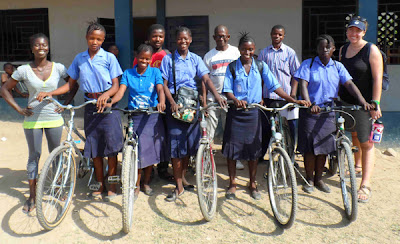
3rd year girls from Baclayon National High School, Philippines
Continuing with our focus on girls on bikes...Bikes for the World recently got word from our Philippine partner Bikes for the Philippines Foundation (BfPFI) that when training boys and girls to ride or work on bikes the best practice is often to separate the sexes.

As with other programs we work with, BfPFI was finding many girls who had never ridden a bike before. Many factors contribute to more boys knowing how to ride a bike from time availability to having a bike to ride.

Village Bicycle Project in Ghana was finding even if they gave bikes to girls to ride, their brothers or other males in the village would often steal them for themselves.
 
In the Philippines each selected student is loaned a bicycle for their sole use, thus eliminating that problem. But when Joel Uichico, Director of BfPFI started training the beneficiaries at Baclayon National High School he noticed a distinct difference when training boys and girls together. Both in riding and maintence training some of the boys were picking it up faster than the girls making training them together challenging.

Uichico said the boys were actually making it harder for the girls to learn at their own pace. And some of them would even refuse to mentor the girls to help them along.

 The education model set up by Uichico hand selected beneficiaries who lived great distances from school to receive bikes through the program in order for them to graduate. He started with the older students, training them in safety, skills, and maintenance. Those students would then in turn help mentor the younger students.

What he found was by separating the students by year and then further into boys and girls, the training was much more productive and focused.

Just as we see here in our cycling circles in DC, men and women are often very different, and some women find it intimidating to learn next to guys. That's why you'll see some bike shops offer classes geared specifically toward women. And bike rides for women only. But once they get the hang of it...On Your Left.

When I visited Baclayon I had the opportunity to ride with our student beneficiaries there. Joel and I joked when we stopped to rest and noticed the girls all removing their helmets and then proceeding to brush and fix their hair. Teenaged girls, we said.

But what I didn't appreciate was the teenaged boys. Uichico recently shared a training observation with us, "Sometimes, the boys would want to teach the prettier girls first. This is all understandable owing to the fact that the children are in their younger teens."

Because no matter how you slice it, boys will be boys no matter what language, what culture, what country. The tiny community of Baclayon on the island of Bohol in the Philippines is no different.

To be fair, I saw nothing but cooperation and camaraderie between the students during my visit. Certainly the skill level did separate the riders, a large majority of newbies being girls. But with time and practice this too shall change.
BfW Outreach Coordinator Yvette Hess
Through the rice paddies, muddy single track, steep rocky terrain of Baclayon, congested traffic of Manila...I never heard one complaint from my generous tour guides, be it the students of BNHS, the Bol-anon cyclists, or Athena and Bans, Champion cyclists, that this girl wasn't keeping up with the best of them. And I did most of it with a camera in hand!

It might take us girls a half a second to gain the respect of our male counterparts, but once we do, there's no stopping us. Guys: try to keep up!


Monday, April 1, 2013

You Go Girl!

The League of American Bicyclists has been focused on women in the cycling community for the past few years now, holding conferences and workshops geared specifically toward women in the cycling community. During the Bike Summit in March in DC Giant USA's general manager, Elysa Walk pointed out, "It's half the population. It's not a niche."

Let me tell you what I think of bicycling. I think it has done more to emancipate women than anything else in the world. It gives women a feeling of freedom and self-reliance. I stand and rejoice every time I see a woman ride by on a wheel...the picture of free, untrammeled womanhood. ~ Susan B. Anthony 1896

Door Secondary School Bicycle Library loans bike to students

The importance of a bike in a girls' hands stretches across the globe. Teaching girls to ride a bike in Africa has been listed as a priority for at least two of our supported projects in Ghana, Sierra Leone, and Namibia. Whether it's the Village Bicycle Project's Learn to Ride program in Sierra Leone or the BEN Namibia backed BEC (bicycle empowerment centre) King's Daughters bicycle shop it's hard to ignore the importance of empowering young women by teaching them to ride.

Cristian Hassan Acosta Villafane teaches a woman to ride
From VBP's blog: For starters, many females in Africa don’t know how to ride, while most males do. They tend to be culturally excluded from riding, for many reasons. Learning to ride is a special gift, one that will stay with them. The gift includes the exuberance of bicycling, balance and speed, girl and machine, confidence, accomplishment.

We found that when we give bikes to girls, they’re too often taken and damaged by the boys. So if we want females to have bikes, we must first supply the males. And early in our involvement, we realized we must teach the females how to ride. It is much easier to teach a young girl than a grown woman. Children don’t have as far to fall, they’re more resilient, and more willing to try new things.
Ramatu Sesay

These young girls will always know how to ride, and no one will take that away. When bikes come around in her life; to her brothers, neighbors, her husband, she’ll ask to use it too, unstuck from the stereotype that bikes are not for girls.

Ramatu Sesay is in the 8th grade at Guadalupe School in Lunsar. Every morning, Ramatu leaves her house at 6 AM to make it to school in time for her first class. She sometimes feels scared walking on the road because the village she lives in is near a mine and there are many large mining trucks speeding along the road as she goes to school. Her new bike gets her to and from school faster leaving more time for chores and studies. The skills she learned in the Learn to Ride program give her the confidence to share the road with pedestrians and traffic and help her travel dangerous roads faster leaving less time on the perilous roads.

We hope to bring you more stories from the girls learning to ride in Africa over the next few weeks so check back for more on their progress. We will also bring you incredible stories of how the bicycle is helping young girls lead better lives aside from just riding.

For now check out the Learn to Ride program in Sierra Leone: